Knees to the Dashboard: How the Auto Industry Keeps Building Cars That Punish Tall Drivers
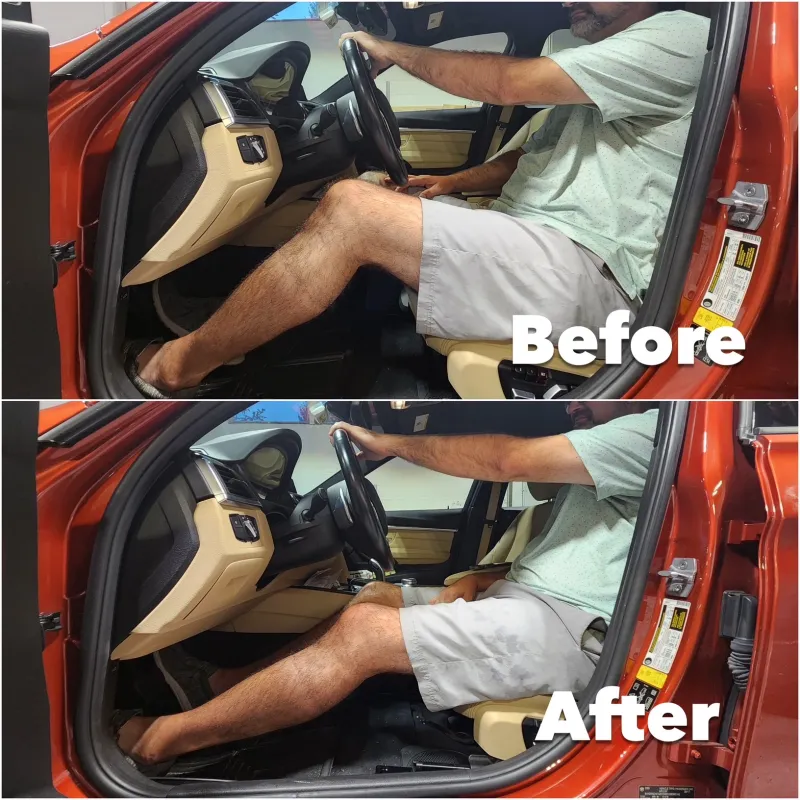
Photo: tall man cramped in car driver seat knees dashboard uncomfortable, via vacmotorsports.com
There's a specific kind of suffering that tall people know intimately. It hits the moment you fold yourself into a rental car at the airport, adjust the seat all the way back, and still find your knees making meaningful contact with the dashboard. You're not driving so much as wearing the car. Congratulations — you've entered the Tall Driver Experience.
For millions of Americans standing six feet and above, buying or renting a car isn't just a logistical decision. It's a medical one. The wrong vehicle means neck cricks, compressed lumbar vertebrae, limited sightlines, and the constant low-grade anxiety of wondering whether your head is actually clearing the ceiling or just grazing it on every speed bump. And yet the auto industry — an industry that spends billions on aerodynamics, infotainment systems, and cup holder placement — continues to treat tall drivers as an afterthought.
So what's actually going on here, and is there any hope on the horizon?
The Myth of the "Average" Driver
Automakers design around a statistical ghost. The industry's ergonomic benchmarks are largely built on mid-20th-century anthropometric data, updated periodically but still skewed toward a median that doesn't account for America's growing population of taller adults. According to the CDC, the average height for American men has nudged upward over the decades, and a significant chunk of the driving population is now in that 6'1" to 6'4" range where car design starts feeling genuinely hostile.
The problem isn't just that tall people exist — it's that engineers optimize for a bell curve, and anyone near the edges of that curve gets squeezed. Literally.
Steering wheel positioning is a prime offender. Many vehicles offer tilt and telescoping adjustments, but the range is often insufficient for someone with long arms and a high seating position. You end up either hunching forward to reach the wheel or sitting so far back that your foot travel to the pedals becomes awkward. Neither option is great when you're doing 70 on the interstate.
The Headroom Illusion
Marketing materials love to brag about "generous headroom" — and technically, those numbers aren't always lies. But headroom measurements are taken at a specific point in the seat, usually with the seat in its lowest position, and they don't account for the full geometry of a tall person's body. Someone who's 6'3" doesn't just need more vertical space above their head; they need a different relationship between the seat, the roofline, and the angle of the windshield.
Sunroofs, which are sold as luxury features, are actually a quiet enemy of tall drivers. Installing a sunroof drops the headliner by an inch or two — and for someone already measuring their clearance in millimeters, that's not a minor inconvenience. It's a dealbreaker.
Then there's the sightline issue. When a tall driver sits in a properly adjusted seat, the A-pillar — that thick structural column between the windshield and the front side window — can block significant portions of the driver's field of view. What's a minor visual obstruction for an average-height driver becomes a genuine blind spot for someone whose eye level sits several inches higher.
Which Vehicles Actually Work
Here's the good news: some manufacturers do get it right, or at least get it less wrong.
Full-size trucks and large SUVs — think Ford F-150, Chevy Silverado, GMC Yukon — tend to offer the most workable geometry for tall drivers. High rooflines, substantial seat travel, and upright seating positions make these vehicles genuinely accommodating. If you're in the market and height is a priority, the truck segment is where you'll find the least suffering.
Minivans are an underrated option that tall people overlook because of the stigma. The Honda Odyssey and Chrysler Pacifica offer remarkable headroom and a seating position that doesn't require a yoga warm-up to enter and exit.
In the sedan world, the Volvo S90 and Genesis G90 both earn consistent praise from tall driver communities for their thoughtful seat adjustment ranges and above-average headroom. Volvo in particular has historically paid attention to ergonomics in ways that other European brands haven't.
Electric vehicles are a mixed bag. The Tesla Model Y works reasonably well for tall drivers, while the Model 3 is notably tighter. The Rivian R1T pickup is getting strong reviews from the tall community for its cabin space and adjustability.
Avoid: most compact crossovers, virtually all sports cars, and any vehicle where the salesperson responds to your height concerns with "you'll get used to it."
The Modification Tax
For tall drivers stuck with a vehicle that doesn't quite fit — whether through necessity, budget, or a lease they can't escape — the aftermarket modification world beckons. And it costs.
Pedal extenders, which bring foot controls closer to a more natural position, run anywhere from $50 to $300 depending on quality and compatibility. Aftermarket seat cushions designed to change the seating angle (and thus drop your head a bit lower relative to the roofline) are another common fix, ranging from $80 to $400. Custom seat rail modifications, which allow for greater rearward travel, can run into the thousands when done professionally.
None of this should be necessary. These are workarounds for a design failure, and tall drivers are paying out of pocket to compensate for an industry that didn't consider them in the first place. Sound familiar? It's the same story that plays out in office furniture, airplane cabins, and medical equipment. The tall tax is alive and well in your driveway.
What Needs to Change
The auto industry is in the middle of a massive technological reinvention. Autonomous driving, electrification, over-the-air software updates — manufacturers are rethinking nearly every aspect of how cars work. This is actually a genuine opportunity.
Some advocates in the ergonomics space have pointed out that as vehicles move toward more flexible interior layouts (particularly in electric vehicles, where the absence of a traditional drivetrain opens up cabin design possibilities), there's real potential to build adjustability into the DNA of the vehicle rather than treating it as a premium add-on.
A few manufacturers are experimenting with memory seat systems that save more granular position data, and there's growing interest in AI-assisted seat adjustment that could theoretically optimize positioning for individual body types. Whether that technology actually reaches production vehicles in a meaningful way — or gets buried under cost-cutting decisions — remains to be seen.
Making Peace With Your Current Situation
If you're tall and already own a car that's less than ideal, there are some immediate moves worth making. Start with a professional seat adjustment consultation — many physical therapists who specialize in ergonomics can help you find the least-bad configuration for your specific vehicle and body proportions. It's not a perfect fix, but it can meaningfully reduce the cumulative damage of daily driving.
Seat wedge cushions designed specifically for tall drivers are worth the investment. They tilt your pelvis forward slightly, which changes your seated height and can open up a bit of extra headroom. Combined with proper lumbar support, this setup won't transform a bad car into a good one, but it can take the edge off.
And when it's time to buy your next vehicle? Test drive it like you mean it. Adjust everything, sit in it for ten minutes, check your sightlines, make sure the sun visor actually blocks the sun from your eye level (not from three inches below it), and don't let a salesperson rush you through that process. Your spine will thank you.
The auto industry built the car for someone else. Until that changes, tall drivers are stuck doing the work of making it fit.