Bespoke or Bust: Inside the Booming Black Market of Custom Goods Built for Tall People
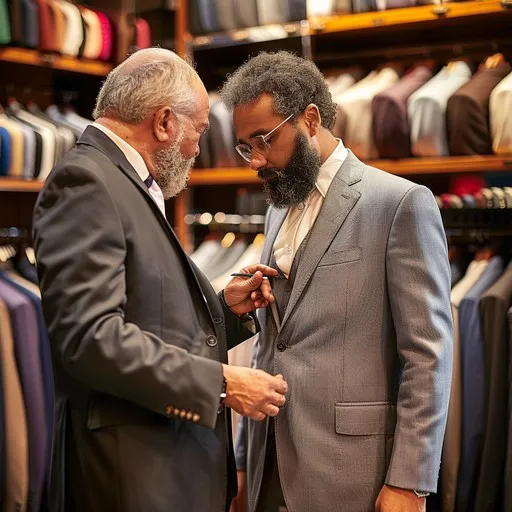
Photo: tall man custom tailored suit fitting in boutique tailor shop, via images.stockcake.com
Let's be honest about something. When you're 6'5" and you walk into a furniture showroom, a mattress store, or a clothing boutique, you already know how this ends. The salesperson smiles, gestures broadly at the room, and then quietly admits there's nothing that actually fits. You leave empty-handed — again — and spend another night with your feet dangling off the edge of a standard queen mattress like some kind of human sofa overhang.
For decades, tall people in America have been quietly absorbing this inconvenience, making do with hemmed-too-short pants, cramped couches, and beds that feel like they were designed for a middle school sleep-over. But something has shifted. A growing network of small-batch makers, boutique craftspeople, and niche entrepreneurs has started building a parallel economy — one that exists almost entirely to serve the customers that mainstream manufacturing forgot.
And business, by all accounts, is very good.
The Gap That Built an Industry
The numbers tell the story before anyone even opens their mouth. The average American man stands around 5'9". Standard product sizing — furniture, clothing, bedding, even cars — is engineered around that median. Which means anyone north of 6'2" is essentially living inside a world that wasn't built with them in mind.
That's not a small group. Estimates suggest roughly 15 million American men stand 6'2" or taller. Add tall women into the mix, and you're talking about a consumer segment with real purchasing power and a very specific, chronically unmet set of needs.
Jordan Hess, who runs a custom furniture workshop out of Asheville, North Carolina, figured this out around 2018 when a 6'7" client came to him frustrated after visiting eleven different furniture stores looking for a sectional that wouldn't leave him sitting with his knees at chest level.
"He said, 'I'll pay whatever it costs to just sit normally in my own house,'" Hess recalled. "That was kind of the lightbulb moment for me. These folks aren't asking for luxury. They're asking for basic functionality. The premium they're willing to pay is just the price of being ignored by everyone else."
Hess now runs a waitlist that stretches four months out. His custom sofas and lounge chairs — built with extended seat depths, raised frame heights, and longer cushion proportions — start at $3,200 and go well north of $8,000 for full sectionals. He says he turns away more business than he takes.
Sleeping Like a Normal Human Being
If there's one product category where tall people have historically suffered most, it might be the mattress. A standard king measures 76 by 80 inches. At 6'4", you're already brushing the edge of that 80-inch length. Add a partner who steals covers and you're basically camping.
A handful of specialty mattress companies have started producing what the industry calls "extended length" or "tall king" options — typically running 80 to 84 inches, with some custom builders going longer on request. Companies like Tochta and a few Etsy-adjacent craftspeople have quietly built loyal followings among tall buyers willing to pay a 20–40% premium over standard sizing.
Marcus Webb, a 6'6" software engineer in Denver, spent $4,100 on a custom 84-inch mattress two years ago. He describes the purchase with the reverence most people reserve for life-changing experiences.
"I cried," he said, only half joking. "I had been sleeping diagonally on a king for six years. The first night on the new mattress, I just laid there completely flat and straight and I genuinely got emotional. That sounds ridiculous but it's true."
It doesn't sound ridiculous at all. It sounds like someone who finally got something that worked.
The Suit That Actually Fits
Clothing is where the made-to-fit economy arguably has its longest history — and its highest price tags. Off-the-rack tailoring has always failed tall bodies in predictable ways: sleeves that end at the forearm, shirt tails that untuck themselves mid-meeting, trousers that hit somewhere between ankle and mid-calf like a reluctant capri.
A new generation of made-to-measure tailors has gotten very good at marketing directly to tall men and women through social media, building client bases that stretch coast to coast without requiring a single brick-and-mortar storefront. Shops like Indochino (which offers extended sizing), along with smaller independent tailors operating out of cities like Chicago, New York, and Los Angeles, have learned that tall clients are loyal, vocal, and extremely willing to refer their equally tall friends.
Then there's the ultra-premium tier — fully bespoke suits starting at $2,500 and climbing fast — where the appeal isn't just fit but the experience of being treated like your proportions are worth accommodating. For tall professionals who've spent their careers tugging at jacket sleeves in boardrooms, that experience carries real emotional weight.
"It's not vanity," said one Chicago-based attorney who asked not to be named. "When you show up to court in a suit that actually fits, you feel like you belong there. When everything's too short, you feel like an imposter wearing a kid's costume."
The Price of Being Served
Here's the complicated part. Everything in this world costs more. Sometimes significantly more. The custom mattress premium can run $500 to $2,000 over standard sizing. Bespoke tailoring starts where off-the-rack ends. Extended furniture pieces can double the price of a comparable standard item. For tall people who are also navigating tighter budgets, this market offers very little.
That tension isn't lost on the makers themselves. Several of the craftspeople we spoke with acknowledged that they're serving a niche that skews toward higher-income buyers — not because they want it that way, but because custom production is genuinely more expensive. Longer materials, more complex patterns, and lower production volume all push prices up.
Some entrepreneurs are trying to thread that needle. A few direct-to-consumer clothing brands targeting tall bodies — American Tall, Tall Slim Tees — have built models that keep prices closer to mainstream retail by manufacturing at modest scale and cutting out the middleman. They're not fully bespoke, but they're not charging bespoke prices either.
What This Economy Says About the Mainstream
The real story here isn't just about niche makers cashing in on underserved demand — though they absolutely are. It's about what the existence of this economy reveals about the mainstream consumer market's persistent failure to adapt.
Tall consumers have been signaling their needs loudly for years through forums, Reddit threads, Facebook groups, and buying behavior. The market has largely responded with a shrug. So a shadow economy filled in, one custom piece at a time, and now it's growing fast enough that some of these niche players are starting to look less like boutique craftspeople and more like legitimate businesses.
For the tall buyers who've found their way into this world — the ones sleeping flat for the first time in years, sitting comfortably in their own living rooms, wearing suits that hit the right inch — the premium feels less like a luxury surcharge and more like the price of being a person whose needs are finally, genuinely met.
That's not a small thing. Even if it does come with a significant invoice attached.